Injection moulding suits high-volume production runs where per-unit cost must stay low, while 3D printing suits low volumes, complex geometries, and rapid iteration without tooling investment. The decision between them hinges on quantity, lead time, material requirements, and budget. This article examines the technical and commercial factors that determine when each process makes sense, and identifies the specific thresholds at which switching from one to the other becomes the more practical choice.
Key takeaways
- Steel injection moulds cost £3,000 to £100,000 upfront but cut per-unit cost sharply at volume.
- Injection moulding becomes cost-competitive with 3D printing between 1,000 and 5,000 units.
- Draft angles of 1° to 2° per side are required for clean part release in injection moulds.
- Injection moulding tooling takes 6 to 12 weeks; 3D printing delivers parts within 48 hours.
- Each mould revision costs £500 to £5,000 and adds weeks, making 3D printing better during design iteration.
- Switch to injection moulding once a design is validated and confirmed orders reach 1,000 units or more.
- Return to 3D printing when a product re-enters design revision or volumes drop below the tooling break-even point.
How Cost Structures Differ Between Injection Moulding and 3D Printing
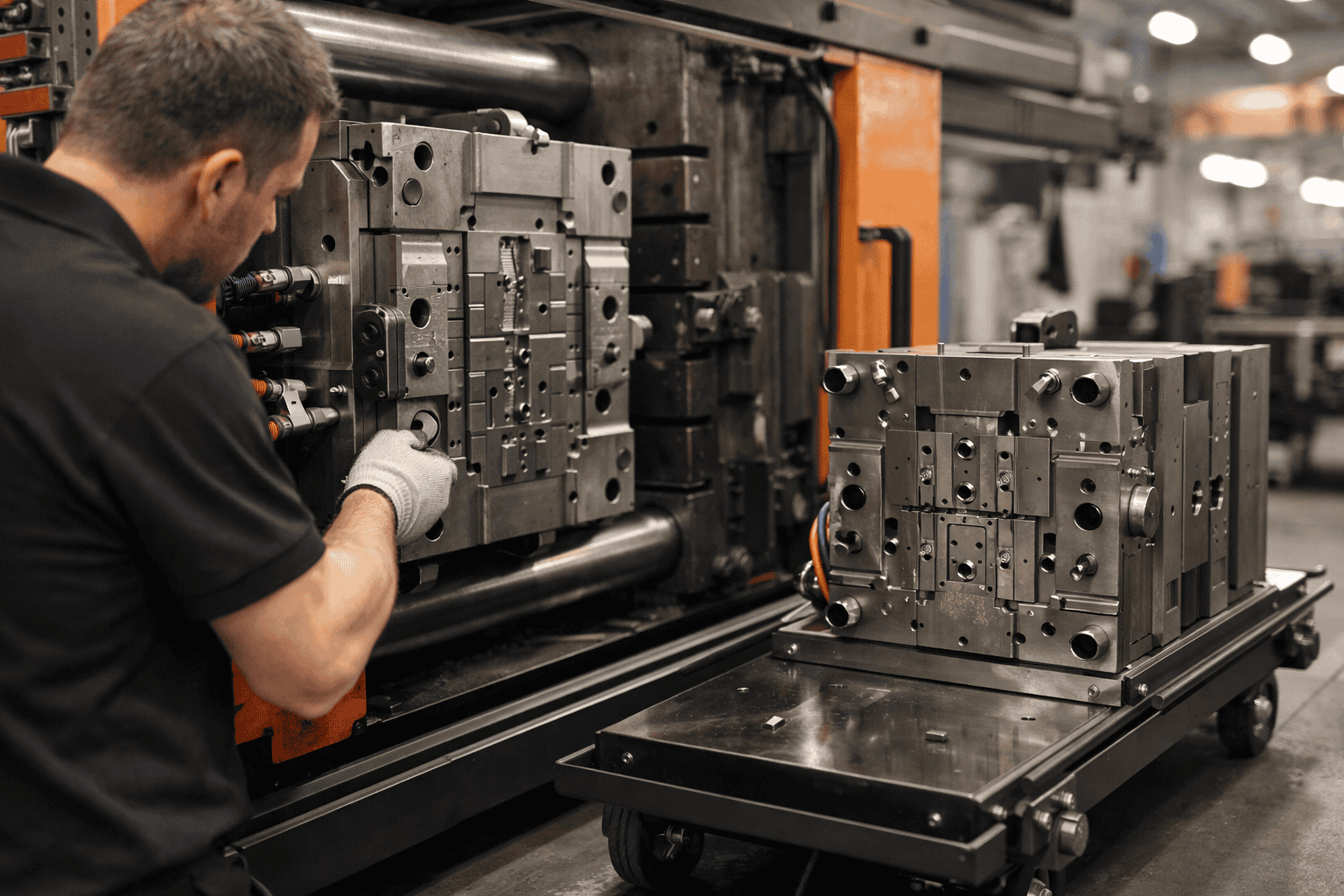
Calculate your expected production volume before committing to either process, because the cost structure of each method is fundamentally different. Injection moulding carries high upfront tooling costs. A steel mould typically runs between £3,000 and £100,000 depending on complexity, but the per-unit cost drops sharply as volume increases. At 10,000 units or more, the tooling investment spreads thin and unit costs can fall below £0.50 for simple parts.
3D printing has no tooling cost at all. Each part costs roughly the same to produce whether you make one or one hundred, which makes it efficient at low volumes but expensive at scale. A part that costs £4 to print individually may cost £0.08 to injection mould at volume.
The crossover point varies by geometry and material, but most manufacturers find injection moulding becomes the cheaper process somewhere between 500 and 5,000 units. Parts that are cnc machined follow a similar per-unit cost curve to 3D printing, useful for prototypes but rarely competitive at production volumes. For high-volume runs, Injection Moulding Services deliver a unit cost that no additive process can match.
Volume Thresholds: When Injection Moulding Becomes the Cheaper Option
- Per-unit cost falls below £0.50 at 10,000+ units
- Holds tight tolerances of ±0.05mm consistently
- Supports advanced materials including PEEK and glass-filled nylon
- Produces fully dense, isotropic parts
- Suitable for regulatory compliance (e.g. FDA-approved resins)
- Lowest cost-per-part above 5,000 units
- High upfront tooling cost of £3,000–£100,000
- 6–12 week lead time before first parts
- Requires draft angles of 1°–2° per side
- Undercuts and internal channels add tooling complexity and cost
- Not economical below roughly 500–1,000 units
- Design changes after tooling are costly
Tooling costs recoup fastest when production volumes are high enough to dilute the initial spend across thousands of units. For most standard parts, injection moulding becomes cost-competitive with 3D printing somewhere between 1,000 and 5,000 units, depending on part complexity, material choice, and mould specification. Above that range, the per-unit cost of injection moulding typically falls well below what any additive process can achieve.
The exact crossover point shifts with part geometry. Simple, single-cavity moulds reach break-even sooner than complex multi-cavity tools. Reviewing the full injection moulding cost breakdown, including material, cycle time, and finishing, gives a clearer picture of where your specific part sits on that curve.
Below roughly 500 units, 3D printing avoids tooling spend entirely and keeps total outlay lower, particularly for prototypes or low-demand components. Between 500 and 1,500 units, the decision depends heavily on tolerances and material requirements. Above 5,000 units, injection moulding is almost always the lower-cost route per part, and the margin widens as volume grows.
Geometry, Tolerances, and Material Constraints That Affect the Decision
| Attribute | Injection Moulding | 3D Printing (FDM/SLA) |
|---|---|---|
| Tooling Cost | £3,000–£100,000 | None |
| Per-Unit Cost at Volume | Below £0.50 (10,000+ units) | ~£4 per part regardless of volume |
| Typical Tolerance | ±0.05mm | ±0.2–0.5mm (FDM, no post-processing) |
| Tooling Lead Time | 6–12 weeks | Same day to 24 hours |
| Draft Angle Required | 1°–2° per side | Not required |
| Z-Axis Strength | Isotropic (fully dense) | Lower than XY plane |
| Material Range | Glass-filled nylon, PEEK, PC blends | Limited engineering materials |
| Cost-Effective Volume | 1,000–5,000+ units | Below ~500 units |
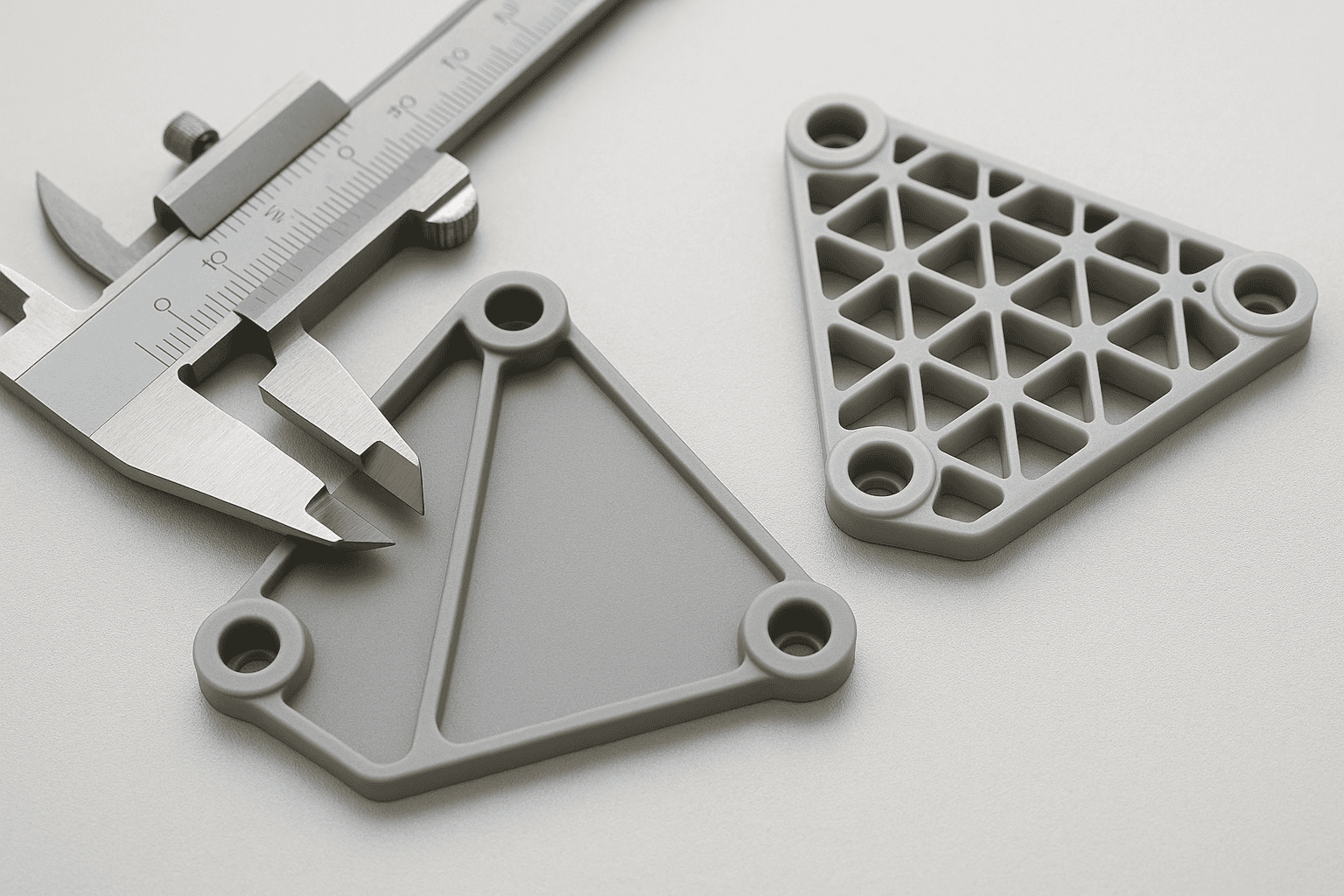
Undercuts, internal channels, and thin walls below 0.8mm cause problems when transferring a part designed for 3D printing into an injection mould. The two processes impose different geometric rules, and ignoring them at the design stage forces expensive rework.
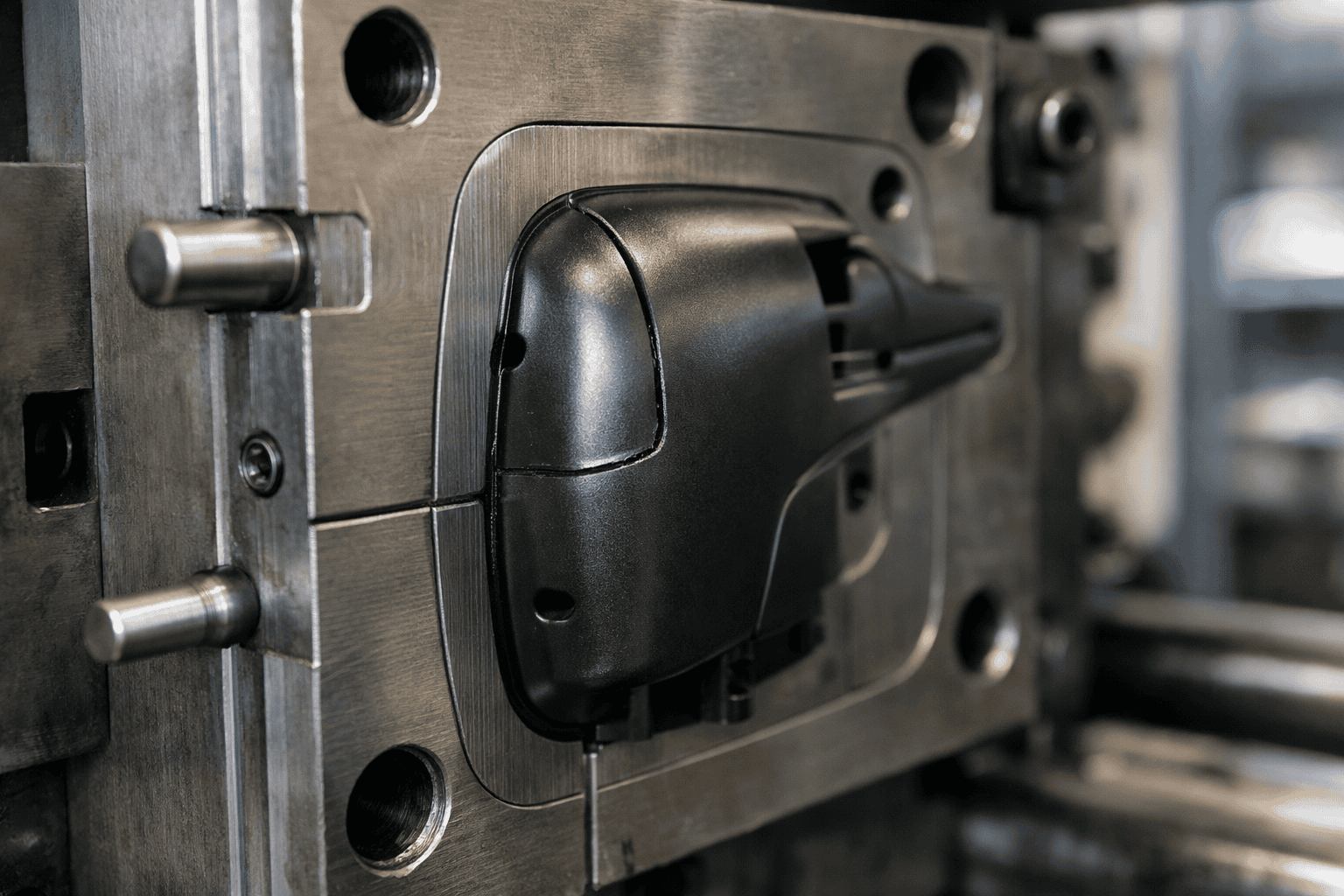
Injection moulding requires a draft angle of 1° to 2° per side for clean part release. Features that cannot be pulled straight from a two-part tool need side-actions or collapsible cores, adding tooling cost and mechanical complexity.
3D printing carries its own constraints. Layer adhesion means tensile strength along the Z-axis runs measurably lower than in the XY plane for most FDM and SLA parts, which can disqualify additive processes for load-bearing components. Tolerances differ sharply too: steel injection tooling holds ±0.05mm consistently, while FDM typically achieves ±0.2–0.5mm without post-processing.
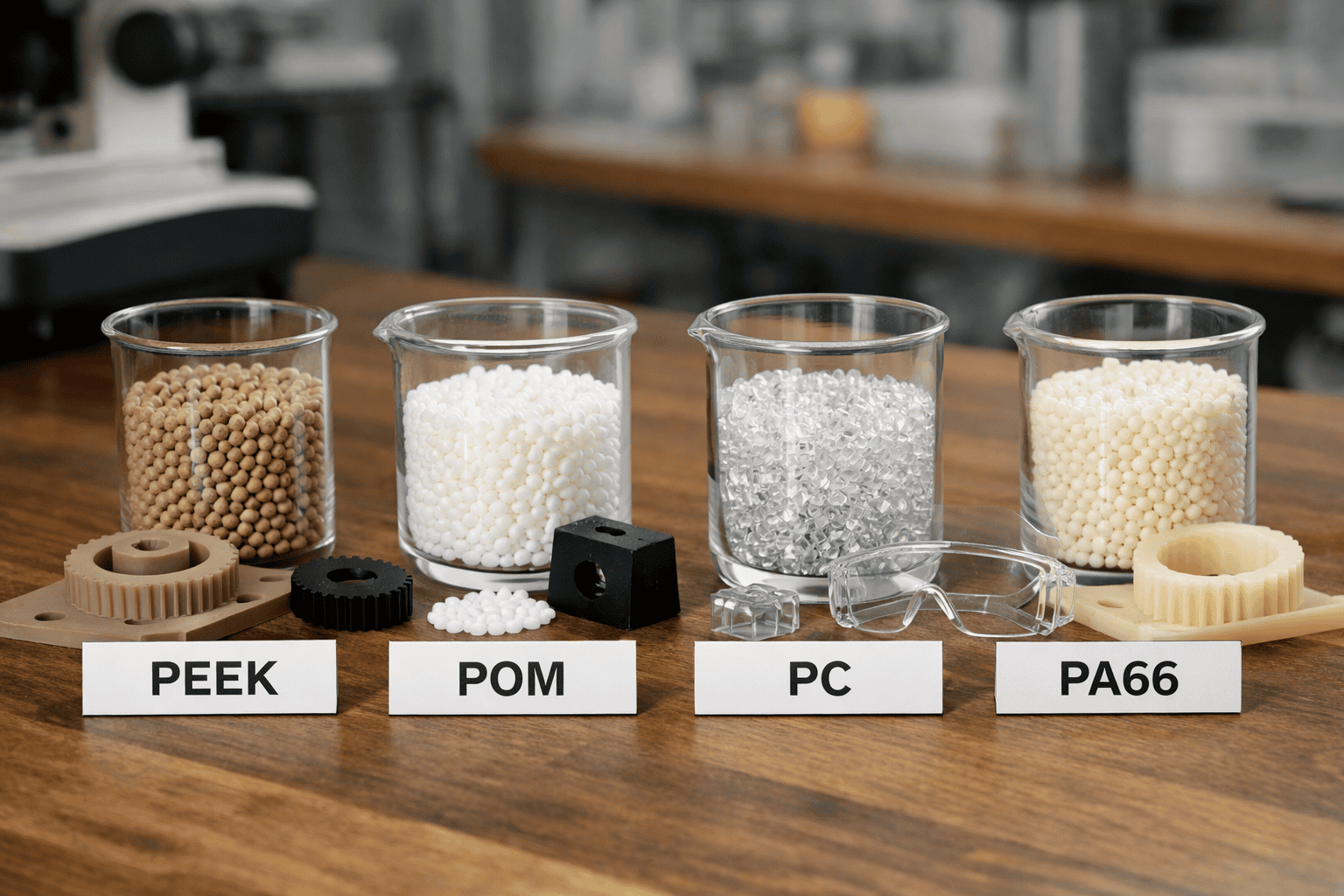
Material selection narrows options further. Injection moulding supports glass-filled nylon, PEEK, and polycarbonate blends processed at pressures that produce fully dense, isotropic parts. Where chemical resistance, UV stability, or regulatory compliance such as FDA-approved resins is required, injection moulding remains the more reliable route.
Speed, Iteration, and Tooling Lead Times Compared
Injection moulding tooling takes 6 to 12 weeks from design sign-off to first parts, making it unsuitable when designs are still changing. A 3D printed part can move from a finalised CAD file to a physical component the same day, or within 48 hours for complex geometries using SLS or MJF.
Each revision with injection moulding may require mould modifications costing £500 to £5,000 and adding weeks to the schedule. With 3D printing, a revised STL file simply replaces the previous one, letting teams cycle through five to ten iterations before freezing a geometry.
Once a design is locked and volumes justify tooling investment, injection moulding cycle times become a clear advantage. Most thermoplastic parts eject in 10 to 60 seconds per shot, allowing thousands of units per day from a single tool. FDM and SLA remain orders of magnitude slower at equivalent volumes.
Run 3D printing until geometry is stable, tolerances are confirmed, and production volumes are known. Committing to tooling before that point risks mould alterations that erase the cost advantage injection moulding is meant to deliver.
Signals That It Is Time to Switch Manufacturing Method
The clearest signal to switch from 3D printing to injection moulding is when per-unit cost outweighs the tooling investment spread across projected volume. Once a design has passed validation and faces a confirmed order of 1,000 units or more, printing each part individually introduces unnecessary cost and dimensional inconsistency that grows with batch size.
Switching back makes sense when a product enters a revision cycle or annual volumes drop below the point where mould depreciation remains economical. If engineering changes are arriving faster than tooling can accommodate them, 3D Printing Services restore iteration speed without committing capital to tooling that may be obsolete within weeks.
Material requirements can also force a switch independent of volume. Parts needing glass-filled nylon, PEEK, or medically certified polymers may exceed what any affordable additive process can achieve at the required tolerance. Where neither additive nor moulding alone meets specification, CNC Machining Services can bridge the gap. If print capacity is consistently holding up assembly, that bottleneck signals the volume threshold has already been crossed.
Frequently Asked Questions
At what production volume does injection moulding usually become more cost-effective than 3D printing?
Injection moulding typically becomes more cost-effective above 1,000 units. Below that threshold, tooling costs (often £3,000 to £50,000 depending on complexity) outweigh the per-part savings. At higher volumes, the unit cost drops sharply, making injection moulding the more economical choice for production runs of 10,000 parts or more.
Which part features and tolerances typically require a switch from 3D printing to injection moulding?
Tight dimensional tolerances below ±0.1 mm are difficult to achieve consistently with most 3D printing processes. Injection moulding also handles thin walls, fine surface textures, and high-gloss finishes more reliably. Parts requiring undercuts, threads, or snap-fit features at production volumes benefit from the repeatability that moulding provides.
How do tooling lead times and design changes affect the best time to move from 3D printing to injection moulding?
Lock your design before committing to injection moulding tooling. Steel moulds typically take 6 to 12 weeks to produce, and each design revision adds cost and delay. Once production volumes justify the per-unit savings, that fixed tooling investment pays back quickly, but only if the geometry is stable.
How do material choices and mechanical properties differ between injection-moulded parts and 3D-printed parts?
Injection moulding supports a broader range of production-grade thermoplastics and produces parts with consistent, isotropic mechanical properties throughout. 3D-printed parts, particularly those made with FDM, are often weaker along layer boundaries and carry more material restrictions. For structural or load-bearing applications, injection-moulded parts typically deliver superior strength and repeatability.
What quality, surface finish, and repeatability requirements signal that injection moulding is the better process?
Injection moulding holds dimensional tolerances as tight as ±0.05 mm across high volumes. Surface finishes reach Ra 0.1 µm straight from the tool, with no post-processing required. If every part must be visually and dimensionally identical to the last, across thousands or millions of cycles, injection moulding is the correct choice.