Faster mould changes start with a lifting solution that moves, positions, and secures moulds safely with minimal manual handling. The right choice depends on mould weight, changeover frequency, press access, and the accuracy needed for alignment. This article explains common lifting options, key selection criteria, and the safety controls that reduce risk during changeovers. It also covers how to match lifting capacity, reach, and attachment points to mould design and shopfloor layout.
Key takeaways
- Select lifting gear that matches mould weight, centre of gravity, and lift points.
- Use quick-connect lifting points to cut rigging time between mould changes.
- Standardise lifting procedures and checklists to reduce changeover variation and errors.
- Inspect slings, chains, hooks, and eyebolts before each lift to prevent downtime.
- Choose spreader beams when lift points sit wide, to control load and alignment.
- Train operators on safe lifting angles, tag lines, and controlled positioning.
Why mould change time stays high even with quick-release clamping
Audit the lifting and positioning steps in your next mould change, not the clamp release time. Quick-release clamping only saves minutes if the tool arrives square, stable, and at the correct height for the platen.
Mould change time stays high when the crane hook, chains, and spreader bar force slow alignment at the press. Operators then “walk” the tool into position with pry bars or repeated inching, adding stops, checks, and resets. Poor lifting points or an off-centre load increases swing, so teams pause to regain control before approaching tie bars and safety gates.
Jib cranes suit single-press cells because the lift path stays short and predictable, reducing waits for shared overhead cranes. Gantry systems cover multiple presses and staging areas, so the next tool can be pre-positioned while the current run finishes. Mould tilters cut time spent rotating heavy tools to access water lines, ejector connections, and eye bolts, while keeping the load supported. Vacuum lifters help when handling large plates or inserts without chains that snag on leader pins and services.
Storage and handling also drive change time. Racks that keep tools at a consistent pick height, with clear access to lifting points, prevent last-minute re-rigging. Good mould design supports this flow; consistent lifting features and sensible draft angles reduce sticking and damage that can turn a planned change into unplanned maintenance.
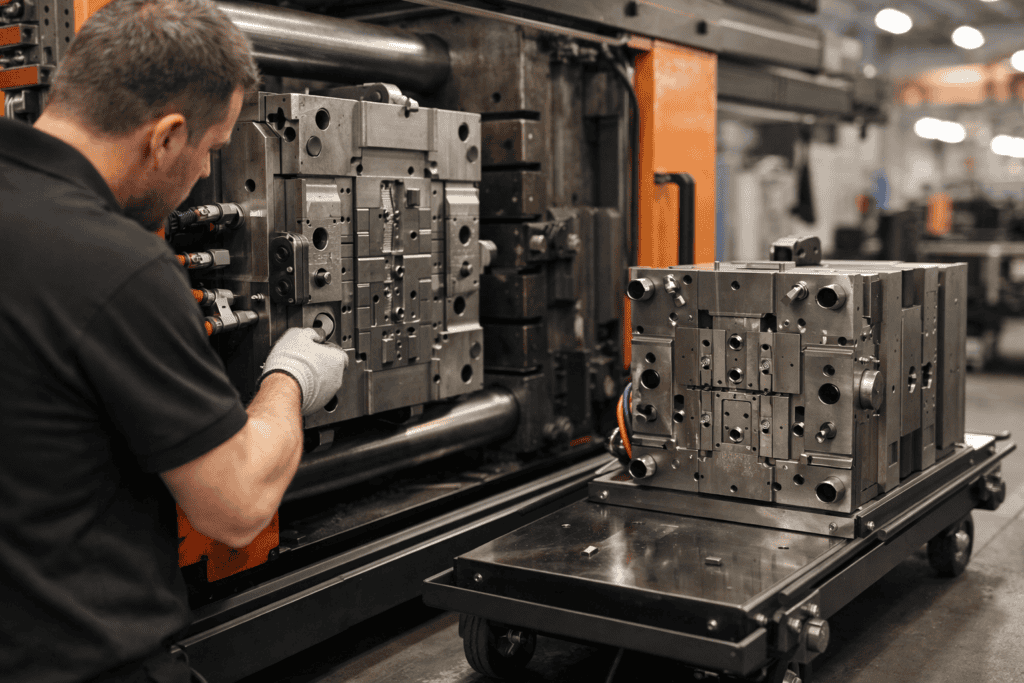
Define the lift-and-position requirements that protect OEE and safety
Cutting 5–10 minutes from each changeover often comes from removing lift delays, not speeding up clamps. Set a lift-and-position standard that delivers repeatable height, level and approach angle at the platen, with no manual “walking” of the tool. Specify the load range, centre of gravity control, required rotation (0–90° or 180°), and clearance between storage and press. Match that to the right slings so the tool hangs square and predictable on every lift.
This protects OEE on two fronts: it shortens the critical path to “tool seated and bolted”, and it reduces stoppages from damaged tie bars, platen faces, water fittings and locating rings. It also lowers risk during the highest-energy part of the change, when suspended loads and pinch points coincide.
- Jib cranes suit high-frequency presses where the lift path stays local and repeatable.
- Gantry systems fit longer travel routes between racking, preheat and multiple machines.
- Mould tilters remove improvised rotation and give controlled, locked positioning for alignment.
- Vacuum lifters work for flat, non-porous tooling faces and reduce sling interference near services.
Jib cranes for fast, repeatable mould handling at the press
The biggest delay often sits between storage and the platen: a high-capacity overhead hook can lift the mould, but it rarely places the tool at a controlled height and approach angle without slow inching.
A correctly specified jib crane turns that lift into a repeatable positioning step. Mount the jib so the hook path reaches the press centreline and the tool staging area, then pair it with a hoist that supports low-speed “creep” travel for final alignment. Add a trolley with smooth traverse and a rotation stop so the mould arrives square, not swinging. Where centre of gravity varies, use a short headroom hoist and a compact lifting beam to keep the hook directly above the pick points.
The outcome is less time spent correcting orientation at the press, fewer pauses for re-rigging, and a more consistent changeover sequence that protects OEE. For high-frequency mould shops, a Lifting Gear Supplier can help match jib reach, slew range, and lifting accessories to your mould weights and pick-point geometry.
Gantry systems for multi-press coverage and controlled tool transfers
Shared lifting capacity across multiple presses cuts changeover time when tool transfer is controlled end-to-end, not improvised with a single overhead hook.
Map the highest-frequency mould routes first. Place a gantry so the beam spans storage, staging and each press centreline without tight turns. Specify a hoist with true low-speed control and a trolley that runs smoothly under load to reduce swing. Use dedicated transfer fixtures per mould family to keep the centre of gravity stable.
- Set standard pick and staging heights so platen alignment starts level.
- Use end stops, marked parking positions and a defined travel lane for repeatable transfers.
- Add mould tilters or vacuum lifters where rotation or non-standard pick points slow positioning.
Common failures include short runway coverage, one rigging set for every tool, and accepting swing as normal. Treat the gantry as a transfer system with fixed routes, fixed fixtures and a controlled final approach.
Mould tilters for accurate alignment, reduced rework, and safer access
Alignment time drops, platen contact improves, and operators stop fighting the tool when a mould arrives level and at the correct approach angle. A mould tilter makes positioning controlled, protecting OEE by cutting micro-stoppages after start-up.
Tilting frames support the mould on a cradle and rotate it under load, typically through 90° for access or 180° for inversion. The tilter controls the centre of gravity, reducing hoist inching and keeping the tool stable. Stable rotation helps present the mould square to the platen, align locating features, and connect services without bars or wedges.
Specify the tilter around the moulds that drive changeover frequency, not only the heaviest tool. Confirm rotation range, maximum offset centre of gravity, and minimum clearance at the press and in storage. Choose powered rotation with a positive mechanical lock when hands-on access is needed for cleaning, inspection, or fitting ancillary parts.
- Fit hard stops or angle indicators for common set angles (for example, service access and platen approach).
- Use dedicated lifting points on the frame to keep sling angles consistent and reduce hook height demand.
- Pair the tilter with a staging stand at press height for a short, controlled transfer.
Track misalignment rework (shim adjustments, re-clamping, first-off scrap) before and after installation to quantify the gain.
Vacuum lifters and storage flow: moving moulds from rack to press without delays
Define the rack-to-press storage flow before refining clamp hardware. Vacuum lifters cut time lost to rigging, re-rigging, and chasing centre of gravity with chains, while keeping the mould face stable in travel and approach.
Vacuum handling suits high-frequency mould shops because it standardises the pick point and reduces swing. A correctly sized vacuum beam or pad array grips a repeatable surface, supports controlled low-speed placement, and keeps hands away from platen pinch points. This consistency protects OEE by cutting minutes spent waiting for a safe lift, correcting a skewed approach, or reattaching slings.
Storage design decides whether vacuum saves time or shifts the delay. Set rack heights for easy engagement, keep clear access to the pick face, and stage moulds in a defined “ready” location aligned to the press approach path. Mark pick zones and travel lanes to keep transfers routine.
Jib cranes and gantry systems still fit when mould geometry has no reliable vacuum surface, surfaces are oily, or loads exceed practical vacuum capacity. Mould tilters suit changeovers where rotation and alignment control matter most. For vacuum systems, validate capacity, safety factors, and control functions against HSE lifting equipment guidance and your site’s lift plan.
Frequently Asked Questions
How does the lifting method affect mould change time and OEE, even with quick-release clamping systems?
The lifting method often sets the pace for the whole changeover, even with quick-release clamps. If lifting needs manual rigging, slow positioning, or repeated alignment, clamps sit idle and change time rises. Stable, precise lifting reduces handling steps and waiting time, which lifts OEE by cutting downtime and lowering the risk of damage or rework.
Which lifting solution fits high-frequency mould changes best: jib cranes or gantry systems?
Choose based on travel needs and floor access. Jib cranes suit high-frequency mould changes when lifts stay within a fixed cell and operators need fast, repeatable positioning. Gantry systems fit best when moulds must move across multiple machines or along a longer path, and when you need clear overhead coverage without relying on a wall or column.
When should a mould shop use a mould tilter to reduce alignment time and handling risk?
Use a mould tilter when alignment work forces manual levering, repeated crane moves, or awkward access to guide pins and clamp faces. Controlled rotation presents the mould at the correct angle, so technicians can seat components faster and with fewer adjustments. It also reduces side-loading on lifting gear and lowers the risk of pinch points and dropped loads.
What mould weight, surface, and access limits determine whether a vacuum lifter is suitable?
Use a vacuum lifter only when the mould has enough flat, sealed area to hold suction reliably. Capacity must cover the mould weight plus the lifter and a safety margin, within the system’s rated load. Access must allow full pad contact and a straight, controlled lift; deep ribs, heavy texture, oil, or porous surfaces can prevent a secure seal.
How should mould storage and staging be set up to cut press downtime during changeovers?
Keep the next mould within 5–10 m of the press, at floor level, before the current run ends. Use dedicated, labelled racks and a marked staging bay that matches the press orientation, with clear access for the lifting device. Pre-stage clamps, bolts, hoses and connectors in a single kit so the change starts immediately.